
What Sidewalks Are For #3
What Sidewalks Are For #3
I have the house to myself this weekend,
which means I’ve been granted the rare adult luxury
of experiencing anxiety without any interruption from what’s real.
Here’s what’s currently headlining this private horror show:
I am trying to make peace with the fact
that I have to pay $1500 to repair a sidewalk I do not own,
because apparently — and mind you I’m just now being caught up to speed on this,
I’m the legal guardian of a troubled adolescent slab in front of my home.
I’m not its dad, exactly. Dad’s at least possess some ceremonial authority.
Dads can tell the thing they are paying for not to stay out past midnight
or let a stranger drag a snowblower across its chest
or say things like,
“No road salt after nine,” and
“I don’t care if every other sidewalk is sinking; you were raised level.”
I don’t get any of that.
I’m more like the sidewalk’s financial sponsor:
responsible for its orthopedic care
while everybody else gets to walk across its face for free.
And so here I am, out $1500 —
which is enough cash to ruin your week,
but not enough to justify fleeing the country.
To demonstrate for you now that my grievance is indeed evidence-based,
here’s a short list I made of alternate futures my $1500 could’ve enjoyed:
a used moped whose rust suggests it once carried a beautiful
but politically complicated woman through Tuscany.1,500 one-dollar bills, which I could dramatically release into the wind while shouting,
“FINE, MUNICIPALITY, TAKE EVERYTHING.”Enough therapy to understand why this bothers me,
but not enough therapy to make it stop bothering me.Roughly 375 coffees, or as Minneapolis calls it, “February.”
Lumber to build a balcony that I could, and I cannot stress this enough, own.
Truckloads of mulch to bury the sidewalk completely
and begin a protracted legal dispute
about whether anyone can prove it was ever there.
Instead of any of that though,
I’m buying a rectangle of gray ground that I do not own.
Can’t sell it. Can’t rent it out. Can’t institute a two-drink minimum.
Can’t install a small tollbooth and charge pedestrians twenty-five cents,
despite my insistence that this would at least teach neighborhood children
several valuable lessons about infrastructure, late-stage capitalism,
and the importance of carrying exact change.
I can’t even stand outside in a reflective vest saying,
WELCOME TO MATT’S SIDEWALK.
PLEASE ENJOY THE INFRASTRUCTURE
I HAVE PERSONALLY FINANCED FOR YOU.
DON’T SAY THANK YOU.
And, if it breaks again, it’s on me to fix it. Again.
For richer, for poorer, in freeze and thaw, till municipal code do us part.
Homeownership, I’m discovering, is mostly a sequence of
the city pointing at various objects near your house and saying, “That belongs to us”
until one of those objects breaks and they clarify, “We meant spiritually.”
The tree belongs to the city, but its leaves belong to you.
The sewer belongs to the city, but the lord of the rings noise coming from it belongs to you.
The sidewalk belongs to everyone, but the bill belongs only to you.
This is less a property system than an extremely abusive form of intimacy.
For PR purposes, I wanna tell you I’ve digested this all with grace.
I would like to say I opened the notice, gazed tenderly toward the street and whispered,
“What a privilege to care for the ground beneath my neighbors’ feet.”
The actual reaction though was less printable.
I ate a sleeve of Oreos for dinner,
became a single-issue libertarian,
and Googled whether a residential lot could secede from Minneapolis.
All this went down a couple of weeks ago now, and I have since recovered perspective —
you know, that profoundly irritating human faculty by which you discover
the thing ruining your afternoon may also have smuggled in a point.
Here’s what that point is:
I have spent my whole life walking over other people’s terrible afternoons.
Their opened envelopes. Their brief loss of faith in the democratic experiment.
Their interrupted plans. Their cold coffee beside the calculator.
Every smooth slab beneath me was once an invoice on somebody’s counter,
money already promised to something better,
and a stranger saying, “This is complete bullshit,”
before repairing the world anyway.
Someone’s furnace money became a safe place for a stranger’s stroller wheel.
Someone’s private resent became our public good.
And so at night now,
when I walk the sidewalks of Minneapolis
and go past porch lights waking one by one
and sprinklers silvering the lawns,
I am aware that I am walking across gifts
whose givers I’ll likely never know.
I think this is how the best gifts work.
I think that gratitude may begin where total ownership ends.
Because the holiest things in our lives were never really ours.
Everything is entrusted and none of it is possessed.
Tended to, but never kept.
The children. The rivers. The body. Each other.
This ridiculous little strip of earth where strangers walk their dogs
and teenagers cut across the lawn
and someone’s grandmother moves slowly toward the bus stop
carrying two grocery bags in her arms
and an entire invisible century in in the bend of her back.
Love has always been a terrible financial arrangement.
No warranty. No favorable interest rate.
We invest everything and we retain nothing.
The miracle though isn’t that the bill arrives.
The miracle is that we keep reaching for the check.
That we keep repairing what other people are allowed to walk on.
That we pour ourselves into things without receiving the deed.
That we plant trees whose shade will fall on somebody else’s shoulders.
That we patch the cracks knowing winter is already backstage cracking its knuckles.
None of this makes $1,500 feel like a bargain.
I still think this is bullshit and I remain spiritually opposed
to pretending expensive things are secretly free
because a local poet managed to find a metaphor in’m.
But peace is not finally loving the invoice.
Peace is standing there after the concrete dries,
looking at this smooth gray path I paid for and do not possess,
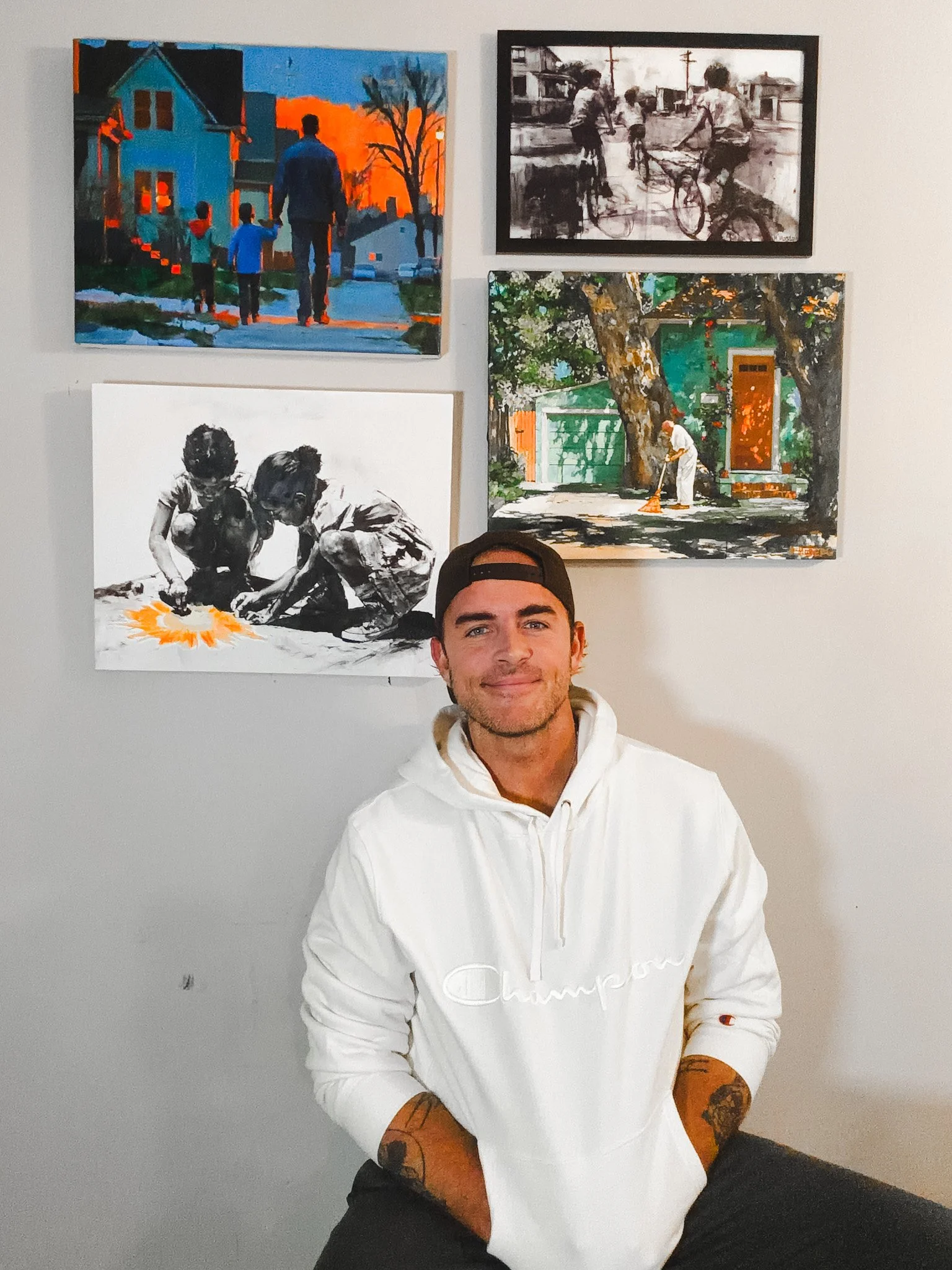
and watching 2 little girls kneel over it and draw a crooked yellow sun
with all kinds of impossible rays.
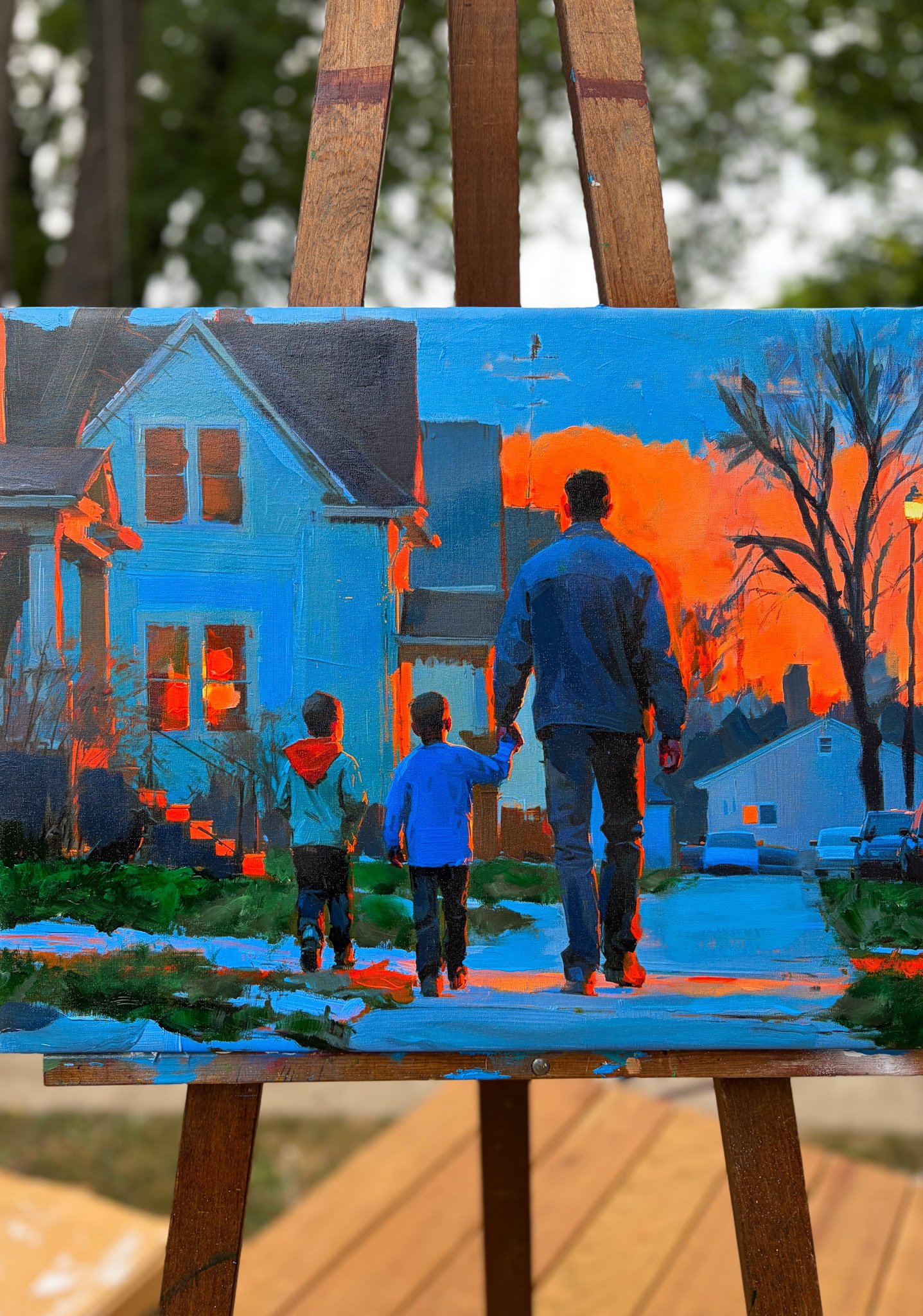
Peace is watching a tired father pull into the garage,
sit for one extra breath behind the wheel,
then climb out and walk the block with his boys
where they’ll tell him everything important that happened to a worm today.
Peace is watching teenagers pop wheelies,
riding the thin bright line between the childhood they are leaving
and the phone call that begins, “First of all, he’s okay.”
Peace is realizing:
There are worse ways to lose $1,500 than beneath somebody else’s joy.
There are worse ways to leave this world
than having made one square of it a little kinder before we go.
That’s the lesson I hope will eventually harden.
Until it fully lands, however, I’m commissioning a sign for my yard that reads:
THIS SAFE AND GORGEOUS CONCRETE PASSAGE
WAS MADE POSSIBLE BY MATT MOBERG,
WHO WAS EXTREMELY NORMAL ABOUT THE COST.
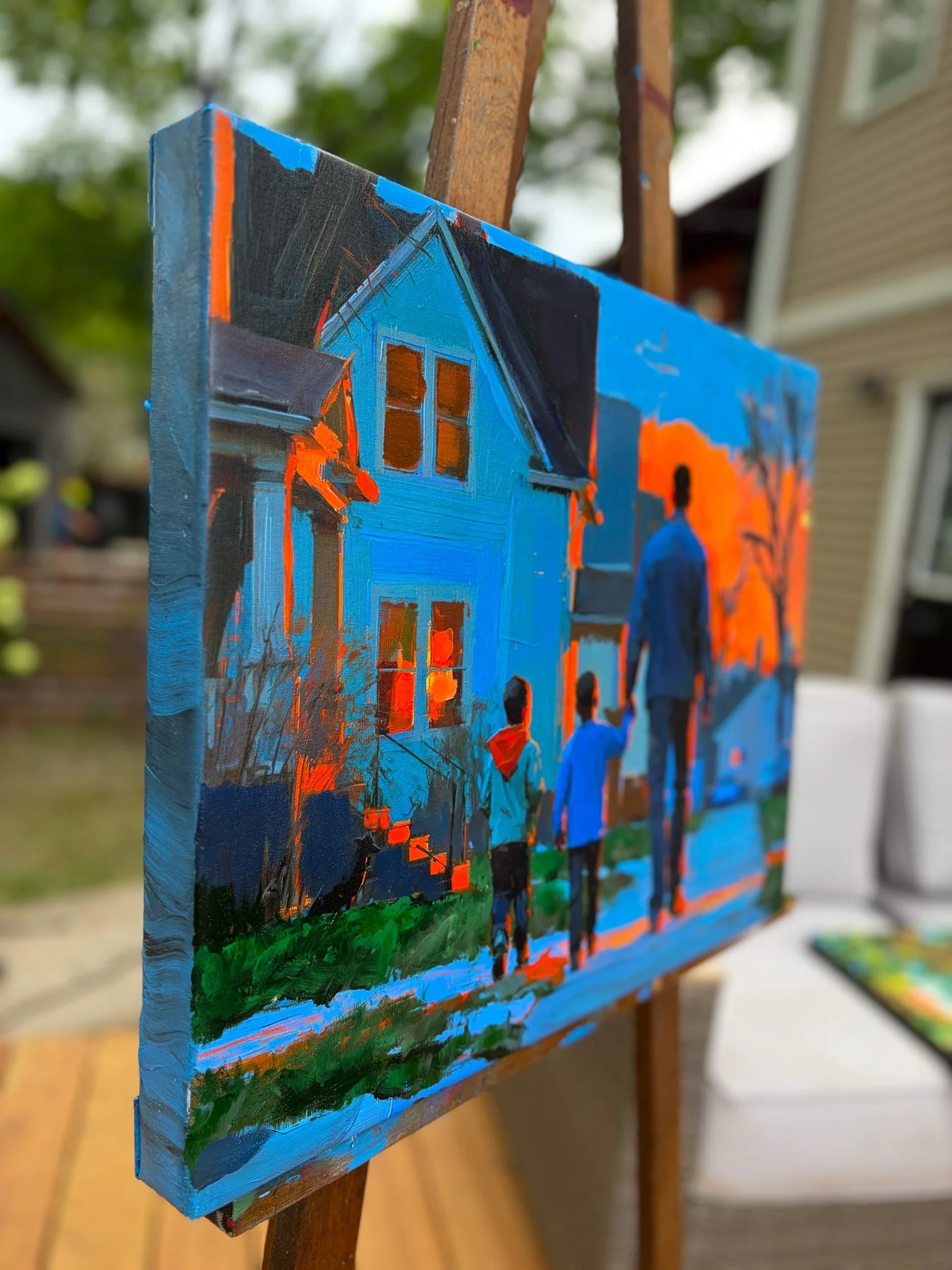
20×16 Acrylic and Oil on Canvas