
It's Okay to Just Be Okay
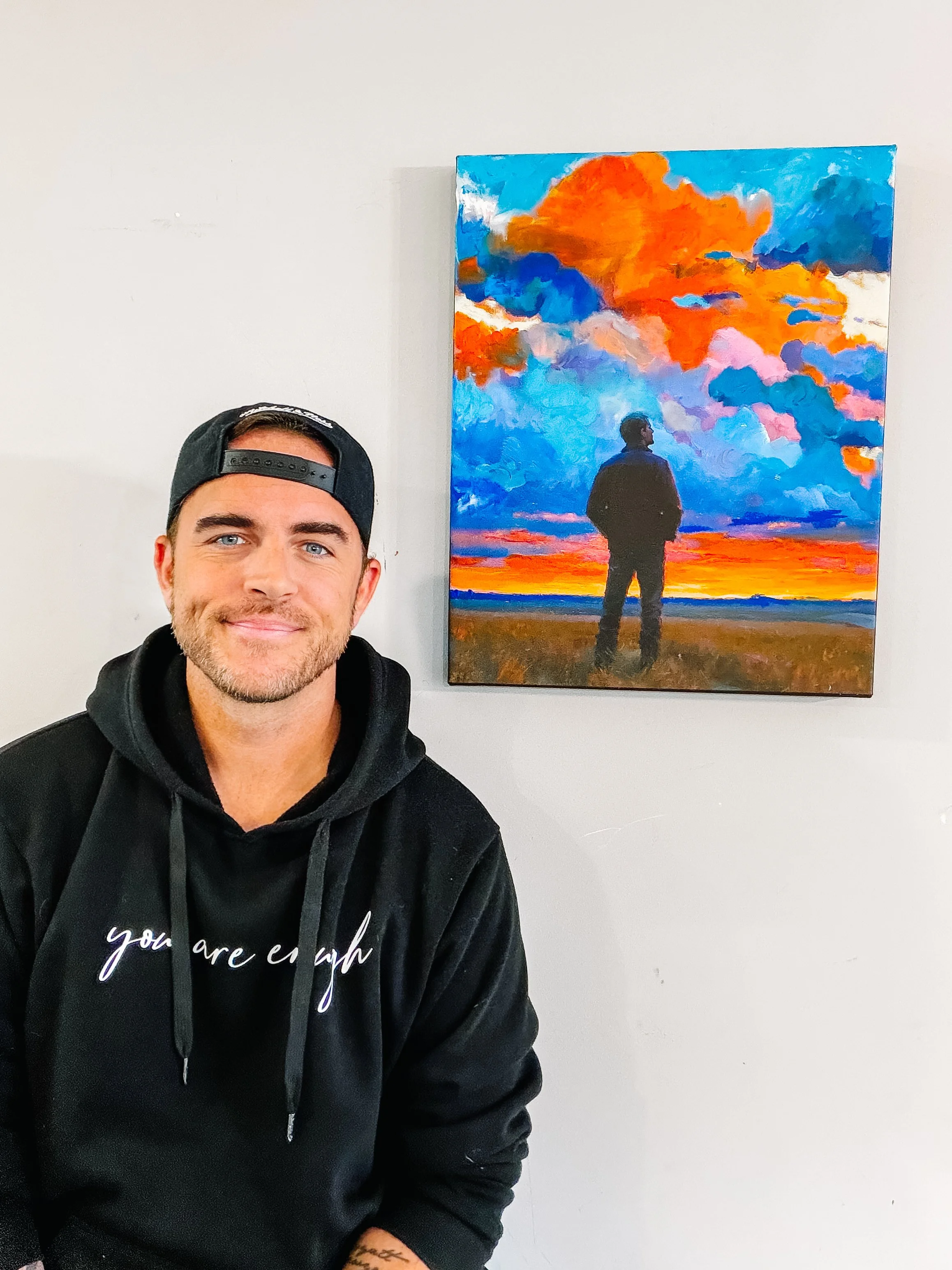
It's Okay to Just Be Okay
I was standing in the self-checkout line at Kowalski’s the other day,
holding a container of wings I consider so good and pure
that describing them as “wings” feels almost taxonomically rude,
like calling the moon a rock or Prince a local musician.
Standing in the line ahead of me was a man wearing a black hoodie.
Across his shoulder blades, and printed in all white caps, were the words:
IT’S OKAY TO NOT BE OKAY.
This is, by now, the unofficial national motto of the emotionally literate era we are in —
a sincere and necessary human mercy that capitalism immediately overheard,
embroidered onto a heavyweight hoodie,
and priced at $80 plus the cost of confronting
why Gary Anderson’s left foot in 1998 became your family’s attachment style.
Despite the machinery and hoopla around it, I think it’s great.
I’m grateful for this sentiment. For the hoodie. For the permission.
Because some of us really need it.
Some of us need to hear that sadness is not a character defect.
Some of us have never heard that grief can sit at the table without needing to say grace.
Some of us have been duped into believing that pain is only palatable after
it’s been converted into a lesson, a testimony,
or at a minimum, a reasonably inspiring Instagram caption.
And so, yes, we need more hoodies like this in the self-checkout line.
More reminders that you are allowed to be unfinished,
that you do not owe the world a convincing performance of wellness.
Now, with that announcement of approval out of the way,
I do want to say that if I had my druthers —
or even the faintest idea around what a druther is,
how many I’m entitled to or where they are traditionally kept —
I would walk up to this man with my own white sharpie and add a second line:
IT’S ALSO OKAY
TO JUST BE OKAY
To exist without a soundtrack behind you.
To be good without needing to glow in the dark.
To stand barefoot on a mountain and allow the sunrise to be a sunrise —
not a revelation, rebrand, or the opening scene of your new personality.
IT’S ALSO OKAY
TO JUST BE…
a man made out of meh.
A human Wednesday with a chance of drizzle.
A weighty 5.8 out of 10.
A Lacroix with the carbonation cut out.
Emotionally available but not currently accepting new clients.
I learned this first in rehab, and if you’ve never been,
you should know that rehab is full of people trying to become new men before lunch.
People who are not even 6 days sober and already prepared to
restore their marriages, forgive their fathers, start nonprofits,
write a bestselling memoir with a colon in the title,
and develop the kind of shoulders that suggest inner peace.
Rehab is a hallway full of broken prophets
carrying Styrofoam cups of Caribou coffee
and speaking exclusively in revelations
they discovered fifteen minutes ago.
Every conversation seemed contractually obligated
to end with somebody leaning back, exhaling slowly, and saying,
“Wow. I really needed to hear that.”
It was usually about boundaries.
Occasionally about skincare routines.
I was good at this sort of performance.
I had been training for emotionally literate group therapy my entire life.
I knew how to enter a room, locate its center of gravity,
and begin quietly campaigning for the office of
Most Memorable Man Present.
I could be funny.
I could be tender.
I could pull a wound from my pocket, teach it three chords,
and send it out on stage to earn its keep.
I could stand in the middle of my own burning house
and explain the architectural advantages of open-concept living.
I actually did that in a group once, or something of that sort,
which is probably why my counselor pulled me to the side after
with the careful expression of someone about to confiscate a weapon and said,
“Matt it’s really ok to just be ok.”
My brow reactively filed an appeal.
Surely she had more to offer up than that.
A coupla metaphors. A handout. A laminated diagram of the vagus nerve.
A worksheet asking me to locate the shame somewhere between
my throat and my childhood and the spot I keep unanswered texts.
I didn’t go to rehab to become the beige throw pillow of mankind.
I’m here for the transformation — the shocking before-and-after photo
that I would’ve got at Farrell’s if I hadn’t quit after the cardio session.
I wanted recovery to make me glow so brightly that airport security
would pull me aside for possessing an undeclared amount of personal growth.
I wanted sobriety to give me cheekbones,
and a soft light that would follow me from room to room.
Instead, I was told that I could be the furniture.
And not even the good one. Not the family heirloom.
Not the gorgeous antique table that everyone huddles around.
She said I could be ok, like the folding chair in the church basement.
Still there. Still useful. Still trusted,
just without the emotional equivalent of a fireworks finale set to “Fix You” by Coldplay.
This didn’t feel like salvific wisdom at first,
and so I went out that night to see if it were true.
I attended an entire dinner with friends, all beige with no backlighting.
I didn’t say anything that could be embroidered onto a pillow.
I didn’t heavy sigh my way into the spotlight.
I even allowed someone else to tell the funniest story in the least funny way.
They butchered the details, confused the characters, and even forgot the dog.
And yet still, when I saw the punchline left stranded with its arms waving in the air,
I did not intervene and the joke died alone somewhere outside of Eau Claire.
But I didn’t.
In fact, not only did I survive the evening, the whole meal felt baptismal —
not because anything dramatic happened,
but because nothing dramatic happened and I was loved anyway.
Despite my failure to earn the evening’s affection
through charm, insight, or emergency comedic intervention, my people hugged me goodbye.
They said they enjoyed me. They asked when I could come again.
I had stopped auditioning and was still given the part.
That night, and the counselor’s advice, continues to heal my life.
There are days now when I enter a room and do not improve it’s resale value.
There are nights where I put my kids down and nothing cinematic happens.
No revelation. No swelling music. No sudden understanding of fatherhood.
Just farts and three young boys in various stages of undress
debating whether Lebron James could beat Grandpa David one-on-one
if Grandpa were allowed to foul without consequences.
Those nights are enough.
What a strange and gorgeous thing it is
to discover that love is not always someone standing at the edge of the road
holding a sign with your name on it.
That healing, after the photographers all go home,
is not becoming extraordinary but becoming unafraid
of your own ordinariness.
That you can go to a party without secretly running for mayor.
That you can have a quiet day without calling it depression.
That you can have a good day without asking it to explain your suffering.
That you can answer “how are you?” with “fine” and mean it.
Okay doesn’t need to be the land between disaster and joy.
Sometimes okay is the destination.
A small country with clean sheets.
A refrigerator humming.
Your children arguing downstairs.
Your pulse minding its own business.
No one leaving. No one arriving to save you. Nothing on fire.
I know we want the advice that’ll unveil our roles as royalty,
but I’ve been saved by becoming the couch. The coat rack.
The man in the corner eating too many pretzels and contributing absolutely nothing
to the spiritual development of the gathering.
And so, to my Enneagram 4’s — those of us who have never met an ordinary feeling
that we could not dress in black, place near a window,
and teach to stare meaningfully into the rain —
here is the truthiest thing I know right now:
The people who love you most will never ask you to carry the room.
They just want you to stay in it.
You and I are allowed to exist at room temperature.
We do not have to arrive boiling or frozen.
We do not have to be the disaster or the resurrection.
It’s okay to just be okay.
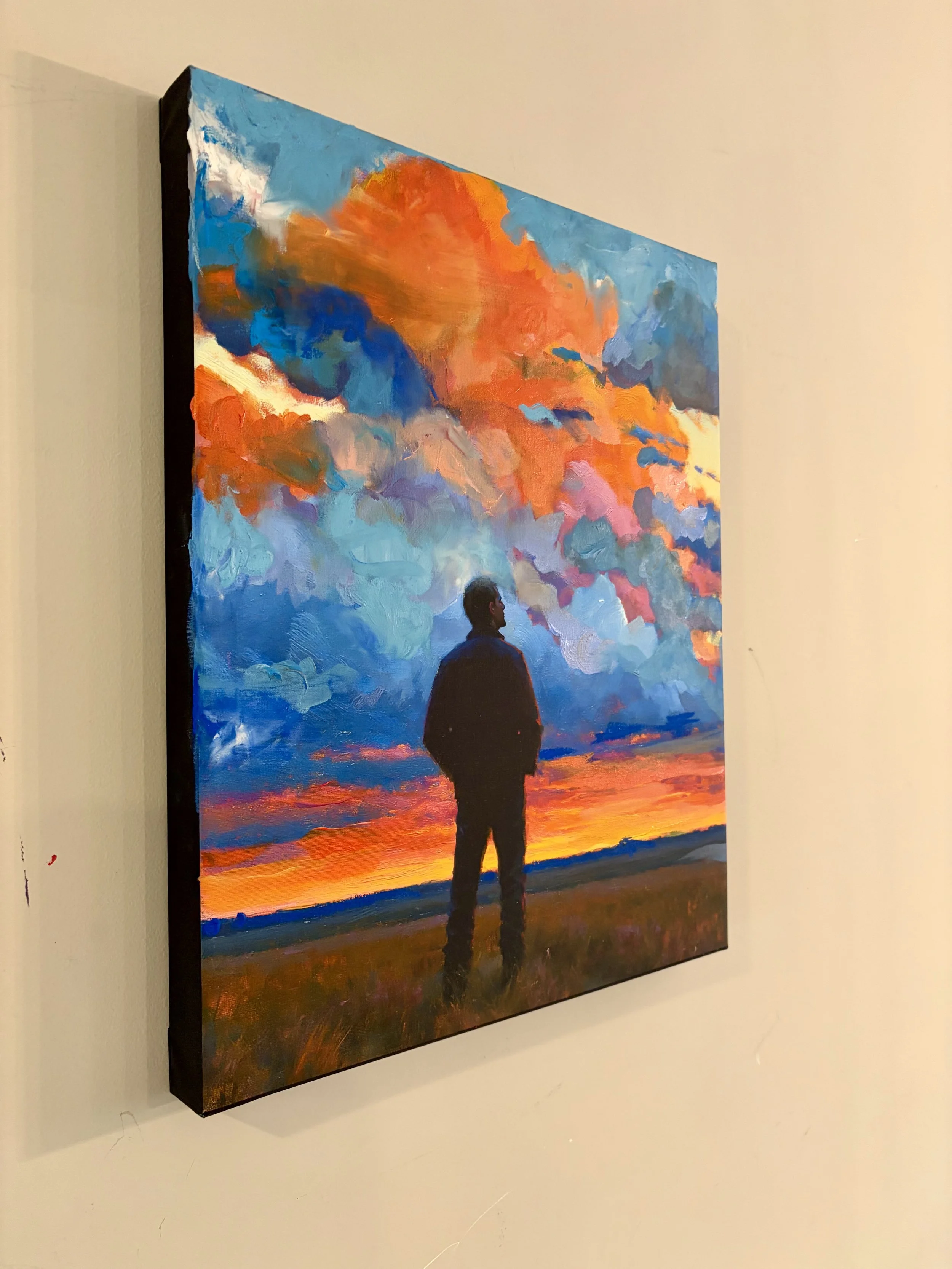
16×20
Acrylic and Oil Pastel on Canvas